Off
About Photos
     Login   |   Sign Up

HOW TO INSTALL CONVERTIBLE TOPS
A Design and Installation Overview

Almost all Ford, GM and Chrysler convertible tops install as two separate units. They are the main top and the rear window section. This is the original design since the thirties and the design is fundamentally unchanged until much later. For example, the Ford Motor Company did not, until 2005, integrate the rear window and the main top into a single unit ! The rear window section is often called the "curtain".

Saab, Toyota and other European cars also employed the two part top design. This manual will emphasize the two part top design and install procedures. But the procedures can also be applied to tops which are made and sold in one piece (unitized.) Most often these are simpler to install because of the pre-integration of the two parts of the top. You don't have to attach the main top to the curtain yourself.

Corvette, in some models and the Chevy Tracker employed unitized tops as did a few other American cars. In some the attachment of the rear window section (which is called the "curtain" in the trade) is partial and there is an open seam along the connection. This allows front to back adjustment. If you know the procedures for two part tops you will find that they inform the procedures in these particular integrated tops.

One of the most popular convertibles, the Mazda Miata, has an integrated top. One company, www.convertibletopguys.com, has specific and easy to follow directions for its one piece replacement tops for Miatas.

Volkswagens (early Beetle, Rabbits and Cabriolets), Mazda RX-7 and Karmann Ghia are examples of cars which should be restored with their own manuals because the procedures involve special rear window installations.

The large 1971-76 GM cars (like the Eldorado and Impala) had complex folding top frames, called scissor tops. Those cars should be restored only with the full scissor top installation manual at hand. This particular top may have to be positioned and repositioned a few times before it aligns just right.

Mercedes and BMW convertible frames are "over designed" and involve some special procedures that are described in those manuals.

For any two part top and for most one part tops, this manual will do two things for you:

  • First it will enable you to make a decision about whether you want to install the top yourself. If you can drive tacks with a tack hammer, or preferably a rented staple gun and if you are patient with the use of contact cement or rubber cement in aligning parts then you are a likely candidate for self-installation. Almost no convertible top requires any sewing.
  • Second, this manual should, if used in conjunction with careful notes and sketches made during the removal of the old top, help you to install your top yourself.

Convertible tops are installed on the car's folding frame. A typical frame is illustrated below. Your car will have a similar frame. It may have one fewer intermediate bows, but it will be quite like the one in the picture. You should absorb the way the frame is designed and also study the terminology.

Removal of the main top begins at the header bow. The new top's installation ends at the header bow. The removal and the installation are essentially the reverse of each other.

SUMMARY OF REMOVAL AND INSTALLATION STEPS

This section will be followed by a detailed look at the removal and installation procedures. The complete manual has been used by many do-it- yourselfers, in conjunction with notes and sketches made during the removal of their old top. If you do not have an old top on the car then you may have difficulties because you will not be able to (1)transfer important locations from the old top to the new top (2) observe the fastening details of the old top (staple size, locations, etc.).

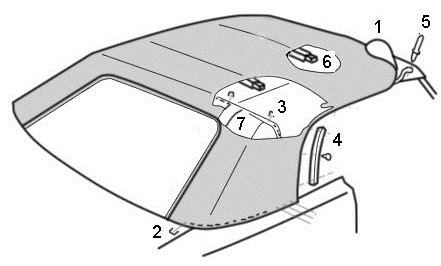
The illustration below is of the layout of the convertible top on the car's folding top frame. It shows the attachment points of a two part top. The way these tops are designed and installed is remarkably unchanged since the early forties convertibles!

(1) The front of the top is attached to a "header bow". In the 1941 Ford convertible the front of the fabric is rolled over a solid wood front ("header") bow. The fabric is stapled to the front edge of the wood bow. By 1950 wood bows were replaced with steel bows. The header bow stapling was done via tack strips which were embedded in the steel bow.

In the illustration below, the number 1 shows the top fabric peeled back off of the header (the first) top frame bow.

Details of top attachment to header bows may vary. Most of the attachment details are going to be covered in this manual. A common example of a header bow attachment would be the following: the front of the top is rolled over the bow and stapled underneath the bow. The staples are driven into an embedded tacking strip (in the under side of the bow.) Usually there is a weatherstrip fastened over the front lip. The illustration at the right shows this header bow design.
The header bow attachment in some cars is a little different. For example, in some convertibles there is a pocket built into the front of the top. This pocket is fitted over the header bow like a hat and glued to the header (or else stapled underneath.) The installer who is unfamiliar with his/her top design will observe the details of the attachment at the header bow, and elsewhere, during the removal process. This removal should be accompanied by careful note taking and even sketches. Removed parts should be stored in labeled bags for re-use in the new top.

The removal of the old top begins at the header bow and the installation of the new top ends at the header bow. So at the start of the job you will be raising the top to allow you to access the header bow. You will study the way the front seal is attached and remove it and store it. You will remove any retaining bar and label and store it, and all screws. You will study the arrangement of staples along the inside edge of the header bow, and pry them out with a screw driver tip. You will make a sketch of the way the corner flaps had been attached.

If you have a manual designed for your particular car and top then it may include all of these details, written out for you. But you should be able to record the necessary information from your study of the old header bow attachment.

This will be true at all attachment points of the top to the framework.

More on header bows later on in the detailed section of this manual.

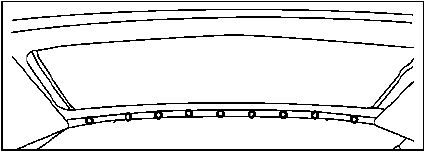
The number 2 in the illustration is of the rear base line of the car. In the illustration, staples are entering the fabric into the back of the rear trim stick. In some models they are stapled in the other direction, into the inner edge of the trim stick. And in a few cars there is no stapling, only a retaining bar that is screwed right against the inner edge of the fabric.

The rear trim stick is usually three separate tacking strips. In early cars they were a fiber that was glued to a chrome molding. Later on the fiber was replaced by a urethane that takes staples.

Trim sticks are bolted to the car. The configuration details vary from car to car and we will cover the major designs of trim sticks. And we will cover how to remove the top and how to transfer important location marks to the new top and how to staple the new top to the car's trim sticks.

The fabric is stapled to the unbolted trim sticks and then the trim sticks are bolted back into the car. More detailed procedures are discussed in following sections.

Modern upholstery shops use air driven staple guns. Some installers use tacks and a tack hammer. Stainless steel staples driven by a rented air driven stapler is the most common mode of attachment for the 'do-ityourselfer.' This will be covered in the installation section following this overview.) If you are comfortable with the idea of using an air driven stapling gun then you are a good candidate for self installation of a convertible top.

Accessing the rear trim stick may involve a few steps and should be logical and doable for the handy individual. There may be an exterior molding that lifts off above the trunk. This would expose staples at the base of the top. The molding studs may extend into the body and be accessible inside the trunk.

A common design has the trim stick bolted against the inner wall of the car with the bolts extending in behind the back seat. The nuts must be accessed from inside the car. Usually the rear quarter trim panels inside the car must be removed and the seat back rest pulled forward in order to access these nuts. Once the nuts are removed and stored the entire base of the top can be seen and the trim stick pulled off of the studs with the base of the top stapled to them. Later in this manual more details will be provided on how tops are attached to the rear trim sticks and removal and installation steps will be described.

(3) In the illustration, the number 3 shows the rear top bow. This is a major attachment point and almost always is done with staples. In Sebrings and a few other cars the fabric is held in place with a removable strip. But usually there is a tacking strip embedded in the rear top bow to accept the staples.

In early convertibles, the stapling is done right down through the topping fabric. An applied molding hides the staples. In modern tops there is a flap or a listing on the underside of the top, right at the rear top bow. This listing staples to the bow. This holds the rear edge of the top and allows it to lay back and over the bow (and to hide the listing.) This eliminates the need for a rear top bow molding.

Here is the basic feature of two part tops: The top of the curtain is stapled to the rear top bow. The back edge of the main top is stapled right over it, on the rear top bow. In the completed installation the top of the curtain is hidden under the back edge of the main top. And the rear side sections (called the "rear quarters") of the main top hide the sides (fabric) of the curtain. As you can see, the curtain is attached before the main top.

The bottom of the curtain and the bottom of the main top's rear quarter sections are stapled at the rear trim sticks along side each other. The curtain bottom is in the center. The rear quarter panels are tacked along side. This is illustrated in greater detail later in the manual.

Note that there has been no sewing done. There is almost never sewing required. The installation process requires stapling and the use of contact cement.

(4) The number 4 in the illustration shows the rear pillar retainer. The top frame has, usually, three hinged sections on each side. Two of them are over the side windows and one is behind the back window. This rear, or vertical, frame piece is the rear pillar.

In some cars the flap of the main top is held to the rear pillar with contact cement. In other cars it is retained by a steel plate. Once again, the attachment process becomes apparent during the removal. And we will show the major methods used in attaching the top to the rear pillar. Also: if you have the manual written specifically for your car it should have the particular steps spelled out.

(5) The number 5 in the illustration shows a rivet or a screw which holds the front end of an important part: the hold down cable. Cables are threaded through the side hems of the top. There is one hem or cable pocket on each side of the main top. The cable (one on each side) is threaded through the top's cable pocket. Its front end is attached near the side of the header bow and its rear end is attached to the frame about two feet back, or more.

We discuss cables later. Your cable configuration will be apparent during the removal process.

(6) The cut away in the picture at number 6 shows an intermediate bow. There are two intermediate bows in the illustration. Some cars have only one. Typically, the attachment at the intermediate bows is very simple. There is a slot built into the under side of the main top where the top aligns with the intermediate bow, or bows. In this slot is a long strip with a screw hole on each end. The strips are saved (removed) from the old top and they slide into the slots in the new top. A screw, from underneath, at each end, pulls the top down to the intermediate bows. This is shown in more detail later in the manual.

The number 7 in the illustration is printed on the right rear top pad. The term top pad or stay pad refers to the covered foam or the padded webbing that runs under the top. In some cars there are two pads, one on each side, from the header to the rear top bow. In some cars there are four (two front and two rear, or quarter, pads.) In the illustration, the number 7 is printed on the right quarter pad. The pads are stapled or riveted along the framework. They serve an obvious purpose. Pads are covered in more detail on the following pages.

New pads are not always required with a top replacement. They often survive through two or sometimes three tops! Tack strips may or may not survive a second top. New cables are always recommended.

This material is repeated in much greater detail in the main manual which follows. For some convertible owners this summary will be a sufficient guide to taking off the old top and transferring the information to the installation of the new top. The rest of this manual goes into greater detail on the procedures involved.

Continue Shopping    |     Back to top

This document is property of M & T Manufacturing. No unauthorized reproductions allowed.


Email questions to: support@mtmfg.com Shipping Warranty
Payment methods

Payment Processing
Copyright © 2012 M&T Manufacturing, 30 Hopkins Lane, South Kingstown, RI 02879